
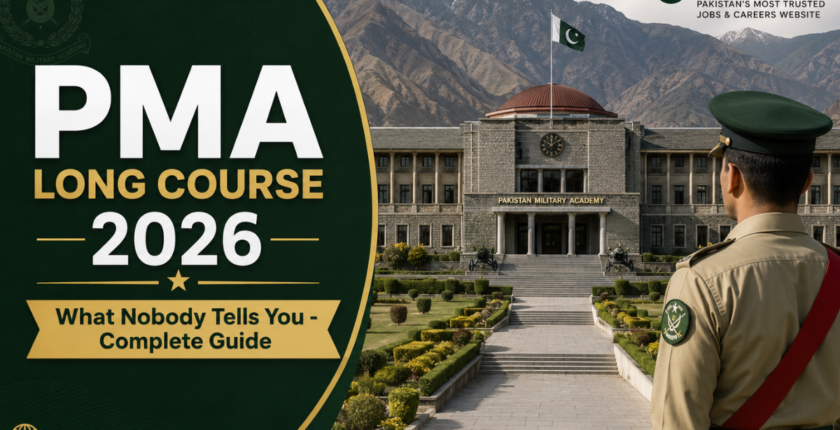
PMA Long Course 2026: What Nobody Actually Tells You
I still remember the day my cousin came home after his ISSB results.
He had prepared for almost eight months. Physical training every morning at 5am. Mock interviews. Group tasks practice with his friends in the street outside our house in Rawalpindi. He had wanted PMA Long Course since he was probably fourteen years old.
He got recommended.
The look on his face that day is something I cannot describe properly. But what I remember equally well is how confused and lost he had been at the START of that journey — because nobody gave him a clear, honest picture of what the whole process actually looks like from beginning to end.
This article is exactly what he wished he had found back then.
First — What Actually is PMA Long Course?
PMA stands for Pakistan Military Academy. It is located in Kakul, Abbottabad.
Long Course is the program through which Pakistan Army selects and trains its regular commissioned officers. When you pass PMA Long Course and complete training, you are commissioned as a Second Lieutenant in the Pakistan Army.
This is not a short service or temporary commission. This is a full career as a Pakistan Army officer.
The “Long” in Long Course refers to the duration of training — which is currently two years at PMA Kakul. After that, you are posted to a regiment or corps as a commissioned officer.
New Long Course batches are announced usually twice a year. The course numbers keep going — at the time of writing this, courses in the 150s are being inducted. ISPR and the Join Pak Army official website announce each new course.
Who Can Apply — Eligibility Criteria
This is where most people get confused because they mix up Long Course with other army programs like PMA Short Course, Lady Cadet Course, or direct commission.
Here is the Long Course eligibility clearly:
Education: Minimum Bachelor’s degree — BA, BSc, B.Com, BBA, or equivalent — from a recognized HEC university. Your degree must be complete at the time of application. Appearing candidates may be considered in some cases but check the current advertisement for confirmation.
Age: 17 to 22 years at the time of course commencement. Age relaxation is sometimes given — again, check the specific course advertisement.
Marital Status: Must be unmarried at the time of joining. Marriage during training is also not permitted.
Nationality: Pakistani citizen only.
Physical Standards — This is Where Many People Get Rejected:
Height minimum 5 feet 4 inches for males.
Weight must be proportionate to height. The army uses a specific weight-height chart. If you are significantly overweight or underweight, you will be screened out at medical.
Vision — unaided vision requirements are strict. Glasses may be acceptable up to certain limits but confirm from the current medical standards. Many candidates with weak eyesight get rejected here. If you wear glasses, check this early.
Physical fitness — you need to be genuinely fit. Not gym-fit. Army-fit. There is a difference. You need stamina, endurance, and functional strength.
How to Apply — Step by Step
Step 1 — Check the Official Announcement
Go to the official Join Pak Army website (joinpakarmy.gov.pk). New Long Course advertisements are published there first. You can also check ISPR press releases and Dawn or Jang newspaper.
Do not rely on WhatsApp forwards for eligibility details. People copy old advertisements and share them without updating the details. Always go to the official source.
Step 2 — Online Registration
Visit the Join Pak Army website and complete the online registration form.
You will need to provide:
- CNIC or B-Form details
- Educational qualifications
- Personal information
- Contact details
- Domicile information
Fill everything carefully. Use the exact same name and details as on your official documents.
Step 3 — Initial Written Test
After registration, candidates are called for an initial written test. This test is conducted at Army Selection and Recruitment Centers across Pakistan — Rawalpindi, Lahore, Karachi, Peshawar, Quetta, and other cities.
The test covers:
- English
- General Knowledge
- Pakistan Studies
- Islamic Studies
- Mathematics and basic reasoning
This test is not extremely difficult, but it filters out candidates who have not prepared at all. Basic preparation of two to three months is enough for most candidates.
Step 4 — Physical Tests
Candidates who pass the written test are called for physical tests.
This usually includes:
- 1.6 km run within a specific time
- Push-ups
- Sit-ups
- Chin-ups or pull-ups
- Ditch crossing and other physical tasks
My cousin told me the 1.6 km run is where a surprising number of candidates fail — not because they cannot run, but because they have never actually practiced running at speed. They train at the gym but never run outdoors. Do not make that mistake.
Start running outdoors on roads or tracks months before your test. Time yourself. Build up gradually.
Step 5 — Intelligence Tests and Initial Interview
After physical tests, candidates appear for intelligence tests and an initial interview at the recruitment center.
This is a preliminary round. Candidates who clear this are forwarded to ISSB.
Step 6 — ISSB
This is the most important and most challenging part of the whole process.
ISSB stands for Inter Services Selection Board. It is a four-day residential assessment held at ISSB centers in Kohat, Gujranwala, Karachi, and Quetta.
ISSB tests your personality, leadership potential, mental strength, teamwork, communication, and officer-like qualities. It is not something you can fake or cram for.
The four days include:
- Psychological tests — written tests that assess your personality
- Group tasks — outdoor physical and mental group challenges
- Individual obstacles — physical tasks you complete alone
- Group discussions
- Command tasks — you lead a group in a task
- Final interview with ISSB President
ISSB results are either Recommended or Not Recommended. There is no in-between.
ISSB Preparation — What Actually Helps
Let me tell you what my cousin said worked for him and what did not.
What did NOT help:
Memorizing model answers for interview questions. ISSB interviewers have seen thousands of candidates. They can tell in minutes if you are giving rehearsed answers.
Pretending to be someone you are not. ISSB is four days long. You cannot maintain a fake personality for four days with trained psychologists observing you.
Last minute crash courses. Some academies charge a lot of money and promise guaranteed recommendations. Most of this is marketing. No academy can guarantee an ISSB recommendation.
What actually helped:
Reading about Pakistan’s history, current affairs, and military. Officers need to be informed and aware.
Physical fitness — genuine outdoor fitness, not just gym workouts.
Group activity experience — debating, sports, leading any kind of group. If you have never led anyone in your life, ISSB group tasks will feel completely alien.
Honestly working on communication. Practice speaking clearly and confidently in both Urdu and English.
Self-awareness — knowing your actual strengths and weaknesses and being able to talk about them honestly.
Medical Examination
Candidates recommended by ISSB go through a detailed medical examination.
This checks everything — eyes, ears, heart, blood, bones, teeth, and more. Medical standards for army officers are strict.
Common reasons for medical rejection:
- Eyesight below required standard
- Flat feet
- Underweight or overweight beyond the acceptable range
- Dental issues
- Blood pressure problems
- Any chronic condition
Get a thorough medical checkup before you apply. If you have a borderline issue, consult a doctor early. Do not find out about a medical problem on the day of your army medical.
What is Life Like at PMA Kakul?
Two years of training that people describe as the most challenging and most transformative experience of their lives.
PMA training is physically and mentally intense. Early mornings, strict discipline, academics, military exercises, weapons training, and leadership development.
It is not a comfortable experience. It is a character-building experience.
Cadets who complete training pass out in a ceremony at PMA Kakul — one of the most proud moments in a Pakistani military family. After passing out, they are commissioned as Second Lieutenants and posted to their respective regiments.
Salary After Commission
After commissioning as Second Lieutenant, your pay and allowances depend on your grade and posting.
Pakistan Army officers receive:
- Basic pay according to BPS grade
- Special military allowances
- Accommodation or house rent
- Medical coverage for self and family
- Ration allowance
- Pension after completing minimum service
The total package is significantly better than the basic pay alone. And it improves with every promotion.
Common Mistakes Candidates Make
Applying Without Checking Eyesight First
Vision is one of the most common medical rejection reasons. Check your eyesight before you go through the whole process.
Ignoring Physical Fitness Until the Last Month
You cannot get army-level fit in four weeks. Start at least six months before your expected test date.
Not Reading the Official Advertisement
Every Long Course may have slightly different instructions, deadlines, or requirements. Always read the current official advertisement.
Going to ISSB Without Any Self-Awareness
Candidates who have never thought about their own personality, strengths, and weaknesses struggle at ISSB. Spend time with honest self-reflection before you go.
Depending Only on Academies
Preparation academies can help with written tests and some interview practice. But they cannot replace genuine personality development and real fitness.
FAQs About PMA Long Course
How many times can I attempt PMA Long Course?
Age is the main limiting factor. You can attempt as long as you meet the age requirement. ISSB has its own rules about repeat attempts — check current ISSB guidelines.
Can candidates with glasses apply?
Vision requirements have specific limits. Candidates with glasses within acceptable limits may be eligible. Check the current medical standards in the official advertisement.
Is there a written test at ISSB?
ISSB includes psychological written tests as part of its assessment process. These are different from the initial written test at the recruitment center.
What is the difference between Long Course and Short Service Commission?
Long Course leads to a permanent regular commission with a full career in the army. Short Service Commission is for a fixed term. Long Course is more competitive.
When is the next PMA Long Course announced?
Check the official Join Pak Army website regularly. New courses are typically announced twice a year.
You can Check All details by yourself at joinpakarmy.gov.pk
Final Thoughts
PMA Long Course is not easy to get into. It should not be. The army is selecting people who will one day lead soldiers in difficult situations.
But it is absolutely achievable with genuine preparation, real fitness, honest self-development, and the right information.
If this is your dream, start today. Not next month. Not after exams. Today.
Run in the morning. Read the newspaper. Work on how you communicate. Build your fitness seriously. And go through the process with honesty and confidence.
The Pakistan Army does not want perfect people. It wants people with real potential, genuine character, and the willingness to be developed into officers.
If that is you — go for it.
Disclaimer: This article is for educational and career guidance purposes only. Zentored is not affiliated with Pakistan Army or PMA. All candidates must verify current eligibility criteria, medical standards, application process, and deadlines from the official Join Pakistan Army website and ISPR before applying.